
Insights
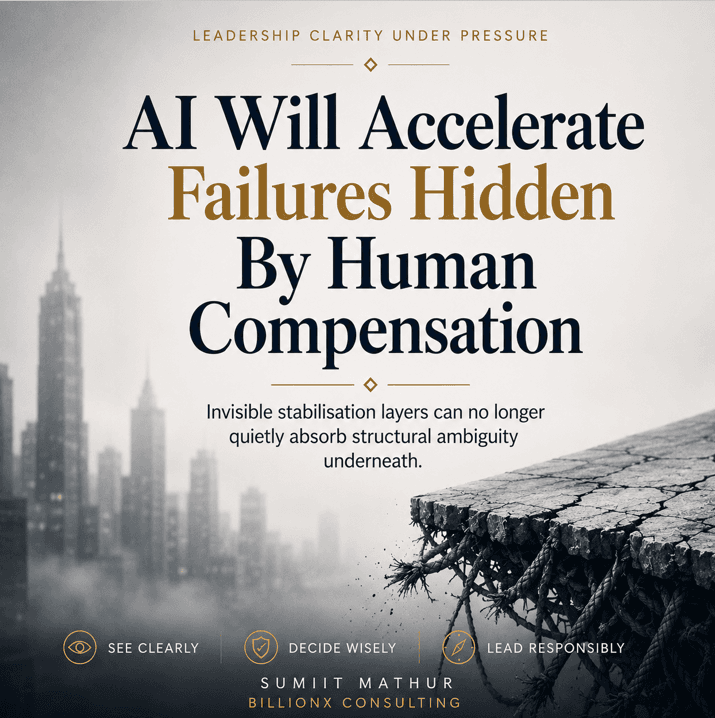
The AI Race Will Expose Invisible Human Stabilisation Layers
"Agentic AI systems do not quietly absorb ambiguity the way experienced people do - they scale whatever conditions already exist underneath. Conditions survivable for years through human compensation may become far more unstable once automation accelerates at scale."
Many organisations currently appear far more operationally stable than they actually are. Not because the underlying environment is fully coherent. But because experienced people quietly compensate for structural ambiguity every day.
They absorb fragmented ownership, undocumented exceptions, conflicting priorities and operational workarounds that were never formally designed into the system.
Over time, this becomes normalised. Leadership teams still see delivery momentum, operational continuity and visible coordination on the surface. And organisational survival gradually starts getting mistaken for organisational coherence.
In many organisations, these conditions have existed for years. Sometimes the business continues growing, scaling and performing successfully despite them - reinforcing the belief that the underlying operating environment is more aligned, resilient and stable than it actually is underneath.
Agentic AI systems operate very differently. They do not quietly absorb ambiguity the way experienced people do. They scale whatever conditions already exist underneath.
Conditions that remained survivable for years through human compensation may become far more unstable once automation begins accelerating fragmented logic, unresolved contradictions and inconsistent operational interpretation at machine speed.
Environments currently surviving through human compensation may begin exposing hidden incoherence much faster once automation becomes embedded into operational flows at scale.
And some of those failures may not remain internal. In some environments, conditions that remained survivable internally for years may become externally visible at machine speed - through operational breakdowns, governance failures, customer impact or catastrophic reputational damage.
The challenge may not ultimately be: 'How quickly can we deploy AI?' It may become: 'How much hidden ambiguity has the organisation already learned to survive with?'
Because once automation begins scaling unresolved organisational friction at speed, leadership teams may discover they no longer understand the organisation as clearly as they believed they did.
If invisible human stabilisation disappeared tomorrow, how stable would the organisation actually be?
This article was originally published on LinkedIn on 14 May 2026.
Continue Reading
Found this useful?
Let's explore what this means for your organisation.
A focused 45-minute conversation — no slide decks, no pitch. Just candid, senior-level thinking about what you're navigating.
Start a Conversation